
Ask five web designers what a website costs and you will get five answers, from a few hundred dollars to well into five figures. They are not all quoting for the same thing. Website prices fall into rough layers, and knowing what each layer includes makes it much easier to compare quotes fairly.
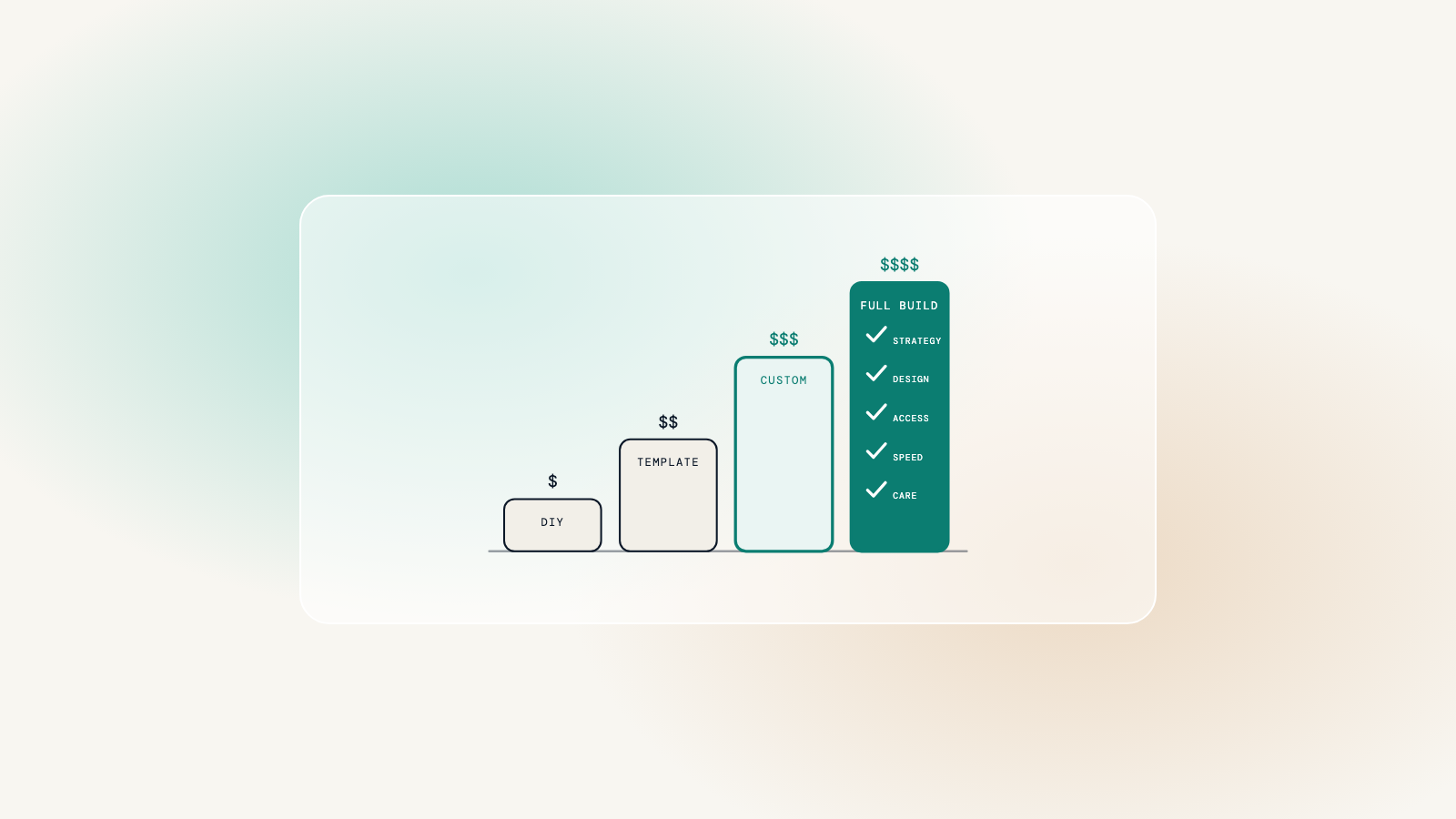
The four layers
Prices vary by market and by project, so treat these as typical US ranges rather than fixed rules.
- Website builder, done yourself: a monthly subscription, plus your own time to design, write and maintain it
- Template site, around $2,000 to $5,000: a ready-made theme with your logo, colors and content added
- Custom look on a page builder, often $5,000 to $9,000: a bespoke design, built with a drag-and-drop tool and a stack of plugins
- Designed and built properly, from around $9,500: strategy, custom design, a custom build, testing, training and ongoing care
What a $2,000 to $5,000 site usually leaves out
At this price, something has to give, and it is rarely the part you can see on day one. A template site can look perfectly good in a screenshot. The gaps show up later.
- Discovery: no time to understand your clients, your services or what visitors need to find
- Structure and content planning: pages follow the template, not how your clients think
- Accessibility testing: rarely done by hand, which leaves people using keyboards or screen readers shut out
- Performance: themes and builders load far more than each page needs, so the site is slow on a phone
- Security and maintenance: set up once, then left until something breaks
- Training and documentation: your team inherits a site nobody explained
A cheap website is rarely cheap. It is usually paid for twice: once to build it, and again to replace it.
Worth knowing
What firms often end up with
For a law firm, a dental practice or an accounting firm, the website is often the first impression a client gets. A low-cost build frequently leads to the same few outcomes.
- A site that looks like competitors using the same template
- Slow pages on mobile, where most first visits happen
- Accessibility failures that are a real legal risk for US businesses
- Simple changes that need a developer, because the builder is fiddly or fragile
- A rebuild within two or three years, when the site can no longer keep up
When a lower budget is the right call
Not every business needs a full build. A new practice testing an idea, or a firm with a very small budget, can be well served by a simple, honest site, and that is far better than no site at all. The important thing is to know what you are buying, and what you are not.
If a full build is not possible yet
There is a middle path. If your current site works but is holding you back, an audit and fix sprint addresses the most important problems at a fixed price, from $2,000, and a care plan keeps it right afterwards. When the time comes for a rebuild, the work done so far is not wasted.